
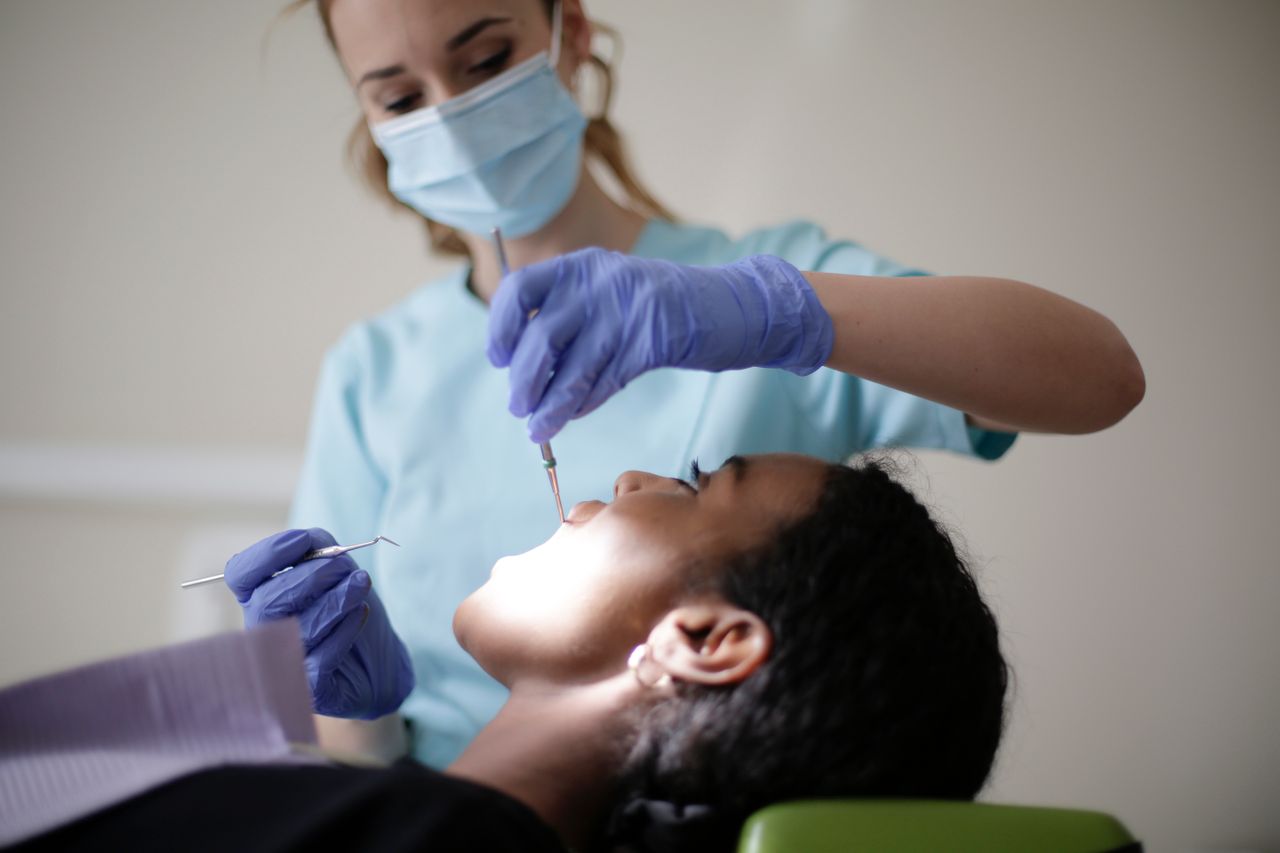

There is a peculiar politeness that descends on people in medical and dental settings.
Adults who would happily query a restaurant bill will sit silently in a chair while something hurts, because the person doing it is busy, and seems to know what they are doing, and it feels rude to interrupt. So they say nothing. They get through it. And then they quietly decide never to come back.
I have been on the other side of this, and I can tell you that no clinician wants that. A patient who says something is far easier to treat than one who has silently written you off.
So let me be plain about what you are entitled to ask for. None of this requires hypnosis, or any special arrangement. Most of it simply requires knowing that you are allowed.
You are allowed a signal that means stop. Agree it before anything begins — usually a raised hand — and expect it to be honoured. Not slowed. Stopped. I speak from experience here: as a child I fainted in a dentist’s chair, having given every signal a child can give short of climbing out of it, and not one of them was read. The two dentists I have had over the past twenty-odd years have been the opposite in every respect, and knowing absolutely that the hand works is most of what makes the chair tolerable.
You are allowed to ask for breaks. For the tray to come out. For a moment to sit up and reset. A procedure broken into three manageable pieces is not a worse procedure.
You are allowed to say that you faint at blood draws, and to ask to lie down for it. This is a reasonable request, not a fuss. Fainting at needles is a specific and well-described physiological response — the blood pressure drops rather than rises — and it is much better managed by a phlebotomist who has been warned.
You are allowed to bring your own music, or your own practised way of being somewhere else, and to say that you would rather not be talked to while you use it. People sometimes worry this seems rude. It is far less disruptive than the alternative.
You are allowed to say that the last time was bad, and why. Especially if the last time was decades ago. Dentistry and anaesthesia have changed beyond recognition, and a clinician who knows what you are braced against can tell you specifically what will be different.
And you are allowed to ask, before anything starts, roughly how long it will take. This one sounds trivial and is not. Knowing the duration changes how the duration feels — a great deal of procedural distress is simply not knowing when it ends.
Two things are worth adding.
The first is that if you have a strong gag reflex, say so early. For most people it is a nuisance at the back of an impression tray; for a smaller group it makes dentistry close to impossible, and impressions, radiographs and dentures become genuinely unworkable. People in that position often stop attending altogether and then describe themselves as lazy about their teeth, which is about as unfair a description as I can imagine. It is a clinical obstacle, not a character flaw — and it is one of the few problems where hypnosis is not the alternative option but the obvious one.
The second is that asking is easier when it is rehearsed. If the thought of speaking up in the chair makes you tense, that is a perfectly good thing to practise beforehand — the sentence itself, said out loud, until it stops feeling like an imposition.
None of this makes anybody enjoy the dentist. Nobody enjoys the dentist. But most of the misery of these appointments comes from the sense of having no say in what happens, and that part is more available to you than you might think.
If you would like to talk through any of this, my contact details are below.
Denise Billen-Mejia, MD CH
Akeso & Aglaia Hypnosis
www.healandberadiant.com officce@aahypnosis.com
Dr. Denise Billen-Mejia is a former emergency medicine physician turned clinical hypnotist, dedicated to helping people find relief that conventional medicine alone hasn’t been able to provide.
To explore further, find articles and resources, or get in touch with Denise directl email office@aahypnosis.com or visit her website: healandberadiant.com
For more great lifestyle content, see here.
Explore more insights at https://dailymailusa.com/.















[…] What You Are Allowed To Ask For […]