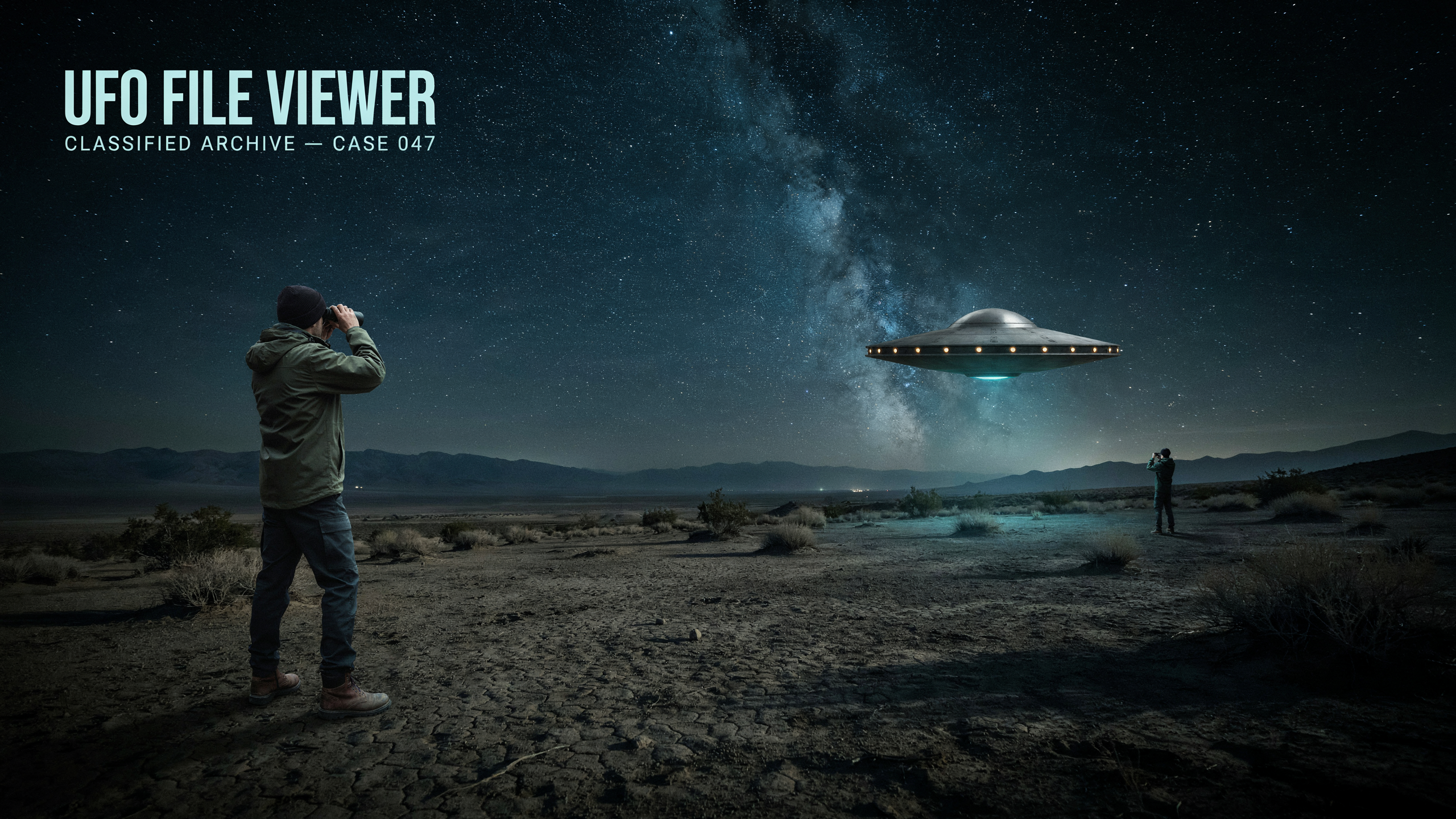

Separating UFO facts from fiction begins with distinguishing what a witness or instrument recorded from what someone inferred. “Unidentified” means available evidence has not established an object’s identity; it does not confirm an extraordinary origin. Investigators compare original images, timelines, viewing conditions, radar data, and independent records with aircraft, satellites, weather, and astronomical sources. They also note missing information and uncertainty. Familiar cases and official summaries can inform analysis, but neither notoriety nor unresolved status proves a particular explanation. The UFO File Viewer provides access to documented material and helps readers explore UFO records. The following sections show how evidence is assessed.
Main Takeaways
- “Unidentified” means a report hasn’t been explained; it doesn’t prove an extraterrestrial origin or threat.
- Record the time, location, duration, viewing conditions, and direct observations separately from estimates and interpretations.
- Preserve original, unedited images and videos, device details, and metadata for reliable review.
- Compare witness accounts with independent radar, flight, weather, and astronomical records, checking whether sources share information.
- Assess sensor limits, camera artifacts, timing, and missing evidence; conclusions should match what the documented evidence supports.
What Counts as a UFO Report?
A UFO report is an account of an observation that its source cannot identify at the time—not proof of an extraterrestrial craft. A useful report records what was seen, where and when it occurred, how long it lasted, and which viewing conditions applied. It may include the observer’s position, direction of travel, weather, nearby landmarks, and whether the object was moving or stationary.
Clear report submission criteria help agencies and researchers compare accounts without overstating conclusions. Reports should distinguish direct observations from estimates, interpretations, and details learned later. Where possible, observers can preserve photographs or video in original form, note the device used, and avoid editing or enhancing files. These documentation methods support review while protecting evidence integrity.
A report can also include relevant context, such as aircraft activity or other witnesses, provided those details are identified as confirmed or uncertain. Accurate records may help public safety personnel assess hazards, assist researchers, and reduce confusion. Careful documentation does not establish a cause; it makes an account more useful for responsible evaluation.
What Does “Unidentified” Actually Mean?
“Unidentified” describes the limits of an observation or investigation, not the nature of an object. The Meaning of “unidentified” is thus narrow: available evidence has not established what was observed. It does not confirm an extraordinary origin, demonstrate a threat, or prove that the case is permanently unsolvable. The Scope of “unidentified” depends on what records, instruments, and follow-up inquiries are available.
For careful reporting, the label should prompt measured questions rather than certainty:
- What remains unknown? A missing detail is not evidence for a preferred explanation.
- What evidence exists? Records may be incomplete, inconsistent, or too limited for a firm conclusion.
- What could resolve the case? Additional data or qualified review may clarify some reports.
- Who could be affected? Unsupported claims can cause needless fear, while dismissing credible concerns can impede public safety.
A responsible account preserves uncertainty without turning it into spectacle. “Unidentified” is a provisional classification, not a verdict. Further evidence may support an ordinary explanation, leave the case unresolved, or justify continued investigation.
How to Separate Observation From Interpretation
Since “unidentified” describes an evidentiary limit, evaluating a report begins by separating what a witness or instrument recorded from what someone infers it means. “A light moved erratically” describes an observation; “the object changed direction instantly” may be an interpretation unless the recording establishes its distance, motion, and scale.
Separating direct observation from personal inference requires careful attention to what the evidence can support. A useful account records time, location, viewing conditions, duration, apparent shape, color, and direction, while distinguishing these details from estimates or explanations. Instruments also have limits: camera movement, focus, exposure, compression, and sensor error can alter an image or measurement. Independent observations may strengthen a description, but agreement does not automatically establish a cause.
Documenting uncertainty without overstating conclusions helps readers assess a report fairly. Treat witnesses respectfully, while keeping confidence proportional to the evidence. Analysts can identify plausible alternatives, note missing information, and state what remains unresolved. This disciplined approach serves the public by reducing confusion without dismissing observations or presenting speculation as fact.
What Official UFO Records Can Tell Us
Government reports can document what observers reported, when and where events occurred, and how agencies assessed available evidence. Their conclusions depend on the quality of the records, sensors, and analyses available. An unexplained case indicates unresolved evidence, not proof of an extraterrestrial cause.
Government Reports
Official UFO reports document what observers described, how agencies assessed those accounts, and which cases remained unresolved—not proof of extraterrestrial origins. Government archives preserve reports, investigative summaries, and records of changing assessment methods. Reporting procedures help distinguish firsthand observations from later interpretation, supporting careful review rather than sensational claims.
- Descriptions: Witnesses recorded apparent shape, motion, duration, location, and viewing conditions. Such details can guide comparison with aircraft, balloons, astronomical objects, or sensor effects.
- Assessment: Analysts considered available testimony and instrument data, assigning explanations when evidence supported them.
- Unresolved cases: Some reports lacked enough reliable information for a confident identification. Unresolved means undetermined, not extraordinary.
- Public value: Accurate records help communities evaluate claims, inform responsible discussion, and respect witnesses without treating sincere perception as conclusive proof.
Official documentation is most useful when read within its stated evidentiary basis.
Limits of Official Records
Even well-kept UFO records have limits: they document what observers reported and what investigators could assess, but may omit vital details or rely on incomplete testimony and sensor data. A file can establish that an event was logged, not that its interpretation was correct. Missing context, uncertain calibration, and inconsistent witness accounts constrain conclusions.
| Record element | What it can show | Important limitation |
|---|---|---|
| Witness statements | Reported perceptions | Memory and viewpoint |
| Sensor data | Recorded signals | Calibration or gaps |
| Case summaries | Investigative steps | Selective detail |
Record retention policies shape which materials survive, while classification delays can restrict timely public review. Responsible analysis distinguishes documented observations from explanations, notes uncertainty, and avoids presenting unresolved cases as proof. Such care helps readers assess claims fairly and supports informed public discussion without overstating evidence or dismissing witnesses.
How Eyewitness Accounts Help and Mislead
Eyewitness accounts can provide details about a sighting’s timing, location, and appearance that instruments may not capture. However, observations are shaped by viewing conditions and human perception, while memory can change over time. Such reports are useful evidence, but they require corroboration and careful assessment.
Eyewitness Observations
What can an eyewitness account establish about an unidentified object? It can document what a person reported seeing, when and where the observation occurred, and which features seemed distinctive. Such testimony can guide investigators toward records, other witnesses, or physical evidence, but it cannot alone identify a craft or prove an extraordinary explanation.
A careful assessment considers:
- Witness credibility: Relevant experience and consistency matter, but sincere testimony is not conclusive.
- Observer training: Trained observers may describe angles, movement, and conditions more precisely.
- Independent reports: Separate accounts can help establish shared details and narrow possible explanations.
- Corroboration: Radar data, photographs, flight logs, or other records can test claims and support responsible conclusions.
Respectful investigation serves witnesses and the public by taking reports seriously while distinguishing observation from interpretation and uncertainty from proof.
Memory And Misperception
An eyewitness report records a person’s experience, but memory is not a precise replay of an event. It can preserve useful details, such as a sighting’s time, location, direction, and apparent movement, especially when recorded promptly. Yet reconstructive memory can alter details as witnesses interpret an unfamiliar object, discuss it with others, or encounter later accounts. Attentional limits also matter: a person focused on one feature may miss distance, scale, or surrounding activity. Darkness, stress, brief duration, and expectations can further shape perception and recall. These factors do not establish dishonesty; they explain why sincere observers may disagree. Investigators can serve the public by documenting accounts independently, distinguishing direct observation from inference, and comparing testimony with photographs, radar data, weather records, and other contemporaneous evidence before drawing conclusions.
What UFO Photos and Videos Can Show
UFO photos and videos can document an apparent object’s shape, motion, brightness, and position relative to its surroundings, but those details rarely establish what the object is. Their value depends on context: image resolution, lens characteristics, exposure, distance, and an unedited original file. Camera artifacts, reflections, compression, and digital zoom can alter apparent form or movement. Without reliable scale and known camera motion, size and speed remain uncertain.
A careful review can protect witnesses from ridicule while preventing unsupported conclusions:
- Preserve original files and metadata; avoid edits that obscure how evidence was recorded.
- Compare multiple frames with fixed landmarks to distinguish object motion from camera movement.
- Note weather, lighting, viewing direction, and nearby aircraft or ordinary sources.
- State what remains unknown, so others can assess the material without being misled.
A striking image may justify further inquiry, but visual resemblance alone cannot identify a craft, prove extraordinary technology, or establish intent. Responsible reporting separates observable features from interpretation and shares uncertainty plainly.
What Radar Data Can: and Can’t: Show
Radar can detect objects and estimate their position, range, and motion, but performance depends on the system, conditions, and signal processing. A radar return alone may not establish an object’s identity or rule out sensor error, clutter, or misinterpretation. Confidence increases when independent radar systems or other reliable observations corroborate the data.
Radar’s Detection Capabilities
Although radar can provide objective records of an object’s position and motion, those records do not by themselves establish what the object was. Radar’s detection capabilities depend on how echoes are collected, processed, and interpreted. Radar signal processing separates possible targets from clutter, while sensor calibration supports reliable measurements of range, direction, and speed. For responsible public understanding, analysts can distinguish four kinds of evidence:
- A detection indicates that a signal met the system’s criteria.
- A track links successive detections into an estimated path.
- Motion data describe measured changes in position over time.
- Corroboration may connect radar observations with independent records.
These distinctions matter because clear reporting serves both public safety and truth. A disciplined account identifies what instruments recorded, preserves uncertainty, and avoids turning an unexplained track into a claim about extraordinary origin or intent.
Limits of Radar Data
Even a well-calibrated radar system records only the signals its design and operating conditions allow it to detect. A return can indicate distance, direction, and changing position, but it does not identify an object by itself. Radar signal processing may filter noise or merge returns; sensor calibration affects measurement accuracy. Weather, terrain, interference, and software settings can create gaps or misleading tracks. Responsible interpretation distinguishes recorded measurements from explanations.
| Condition | Possible effect | Evidentiary limit |
|---|---|---|
| Rain or clutter | Faint returns obscured | Detection may be incomplete |
| Calibration drift | Position estimates shift | Precision is reduced |
| Processing filters | Signals removed or merged | Track detail may be lost |
A radar display is consequently not a photograph or a complete account of an event. Its data supports bounded claims about detected signals, not certainty about their cause, shape, or identity. Careful reporting protects public understanding.
Corroborating Radar Evidence
When radar records are compared with independent observations, they can strengthen evidence that a signal or track was present, but they do not by themselves establish what produced it. Responsible analysis asks whether separate systems recorded the same event and whether their limits are understood.
- Radar calibration records help determine whether equipment was operating within documented tolerances.
- Sensor synchronization checks establish whether radar, visual, and other reports align in time.
- Agreement across independent instruments can reduce the likelihood of a single-sensor error, though shared interference or processing faults remain possible.
- Missing records, uncertain coordinates, or inconsistent timing can leave observers without a reliable identification.
These checks protect the public from premature claims while respecting witnesses’ accounts. Corroboration supports a narrower conclusion: multiple sources may have detected a phenomenon. Identifying its cause requires further evidence, transparent methods, and careful review by qualified investigators.
How Context Shapes UFO Reports
A UFO report records an observation, not an identification, and its interpretation depends partly on the circumstances in which it was made. Time, location, weather, viewing angle, and duration can affect what a witness notices and remembers. For example, a brief sighting from a moving vehicle offers less detail than a sustained view from a stable position. Distance and scale can also be hard to judge without familiar reference points.
Cultural expectations can shape the words witnesses use and the meaning they assign to unusual lights or shapes. Situational awareness also matters: fatigue, stress, divided attention, and prior knowledge can shape perception without making a witness dishonest. Reports gathered soon after an event may preserve details more accurately than later recollections, though memory remains imperfect. For readers seeking to serve others, careful documentation means treating witnesses respectfully while distinguishing what they directly observed from what they inferred. Context helps explain a report’s limits; it does not establish an object’s identity.
How Investigators Test Ordinary Explanations
Investigators test ordinary explanations by comparing a report’s details with known sources, such as aircraft, satellites, astronomical objects, weather effects, and ground-based lights. They examine timing, direction, apparent motion, brightness, and viewing conditions, then consult flight records, satellite predictions, weather data, and astronomical charts. Witness accounts are valuable, but memory and distance estimates can be uncertain; independent observations and original recordings provide stronger checks.
Investigators compare witness reports with flight, satellite, weather, and astronomical data, while accounting for uncertainty in memory and distance estimates.
A careful review can spare witnesses from ridicule while preventing unsupported conclusions:
- Match the reported time and position against aircraft and satellite tracks.
- Check whether planets, meteors, clouds, or reflections match what was observed.
- Assess camera settings, sight lines, and possible parallax before judging movement.
- Preserve records and explain uncertainty clearly, so others can evaluate the evidence.
When reports persist, Controlled field experiments may test specific claims under repeatable conditions. Instrument calibration helps verify sensors record accurately, while comparison with known objects reveals limitations. Investigators should report both findings and unresolved gaps, serving the public through transparency rather than speculation.
What Famous UFO Cases Reveal: and Don’t
Famous UFO cases can show how observations, records, and later interpretations shape a report, but notoriety doesn’t establish an extraordinary cause. The legacy of the Roswell incident shows how conflicting accounts, military secrecy, and popular retellings can turn an uncertain event into a lasting cultural story. Its fame reflects public interest, not proof that an extraterrestrial craft was recovered. The Phoenix Lights history likewise illustrates why reports must be separated by time, location, and viewing conditions. Witnesses described lights across Arizona in 1997, while explanations included flares and aircraft; the label “Phoenix Lights” groups observations that may not share one source.
Such cases can help researchers identify what was seen, what was recorded, and what remains unresolved. They also show why respectful inquiry matters: witnesses should be heard without ridicule, while claims should be assessed against verifiable evidence. A famous case can guide careful questions, but cannot, by itself, settle what happened or justify conclusions beyond the available record.
What Later Reviews Reveal About UFO Cases
When UFO cases are reviewed years later, new records or improved analysis can clarify parts of the account without resolving every uncertainty. Archival reassessments may uncover radar logs, witness statements, or administrative notes that were unavailable to early investigators. Such material can correct timelines and expose gaps, but it does not automatically establish an extraordinary explanation.
Later records can clarify timelines and expose gaps, but they do not automatically resolve every uncertainty.
Later reviews commonly reveal four distinct outcomes:
- A reported object matches an aircraft, balloon, or other known source, easing concern while correcting the record.
- A sensor’s limits explain an apparent anomaly, though the witness’s experience remains sincere.
- Conflicting documents leave essential details unresolved, reminding reviewers that uncertainty is not proof.
- Case reclassifications reflect better evidence or revised standards, not necessarily concealment or confirmation.
For researchers and public servants, careful review supports informed decisions and respectful treatment of witnesses. It also preserves a distinction between what records document and what investigators infer. A case can become clearer without becoming conclusive, and transparent limits help prevent unsupported claims from shaping public understanding.
How to Judge New UFO Claims Carefully?
The same caution used in older case reviews applies to new UFO claims: judge each account by the quality, independence, and limits of its evidence. Source verification should come first: investigators can identify who recorded an observation, when it was documented, and whether the witness had direct access to the event. Claim chronology helps reveal whether details appeared promptly or changed after publicity, interviews, or exposure to other accounts.
Photographs, video, radar records, and sensor data require examination of original files, metadata, equipment, and possible environmental explanations. Multiple reports do not necessarily provide independent confirmation if witnesses shared information or relied on one source. Researchers should distinguish observed facts from interpretation, record uncertainties, and compare plausible explanations without treating unfamiliarity as proof of extraordinary origin.
A careful assessment also protects witnesses from ridicule while avoiding premature conclusions. Update findings as credible evidence emerges, and leave unresolved cases unresolved rather than presenting them as established facts.
The UFO File Viewer presents documented records for review, but a document’s existence does not establish every claim it contains. Its value lies in the evidence preserved: dates, locations, testimony, and later analysis. Some records remain incomplete or ambiguous; others gain context as additional information emerges. Careful judgment separates documented facts from interpretation, weighs competing explanations, and acknowledges uncertainty. New claims merit the same scrutiny, regardless of their source, publicity, or apparent significance. Explore the UFO File Viewer.