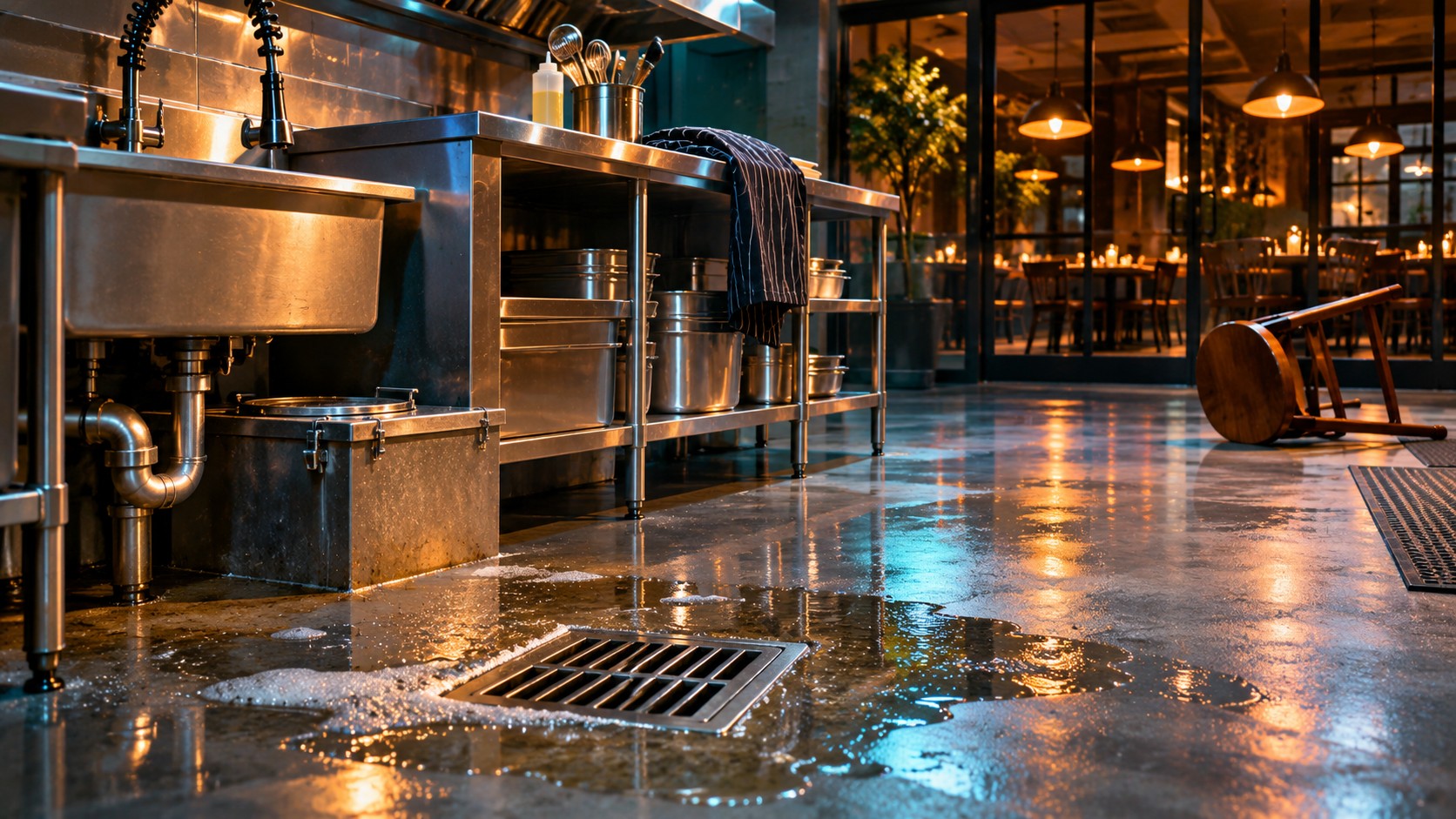

A restaurant can have a full reservation book, an experienced kitchen team and deliveries arriving on schedule, yet still face a serious interruption because wastewater has nowhere to go. A blocked commercial drain may begin as an unpleasant odor or a sink that empties slowly. By the time water backs up onto the kitchen floor, the problem can affect food preparation, sanitation, employee safety and the ability to operate the premises.
For restaurant owners, plumbing reliability is not simply a maintenance expense. It is part of operational continuity. A drainage failure during a busy service period can disrupt several connected activities, from washing equipment and preparing ingredients to cleaning work areas and managing wastewater.
Much of that risk develops gradually. Cooking oils, food solids and grease can accumulate in drainage systems over time. Grease-control equipment requires maintenance, staff need appropriate waste-handling procedures, and building operators must understand which fixtures discharge into the relevant systems.
These responsibilities often receive less attention than customer service, food purchasing or labor schedules. Yet a restaurant’s ability to operate depends on the infrastructure behind the kitchen as much as the equipment inside it.
How a small drainage problem becomes a restaurant-wide interruption
Consider a hypothetical restaurant preparing for an evening service. The kitchen has completed its initial preparation, tables are being arranged, and employees begin noticing that a preparation sink is draining unusually slowly.
At first, the problem appears manageable. Staff continue working while the drain is monitored. Later, wastewater begins returning through a nearby floor drain. The kitchen manager now has to determine whether the affected area can remain in use, which equipment must be taken out of service, and whether professional assessment is required before operations can continue.
This scenario is illustrative, not a report of a specific restaurant incident. It demonstrates why the operational effects of a plumbing problem can be much larger than the cost of clearing one obstruction.
A kitchen depends on connected systems. Sinks, floor drains, dishwashing equipment and wastewater piping may share portions of the drainage network. An obstruction downstream of several fixtures can affect more than the location where the first warning sign appears.
The severity depends on the building’s design, the location of the obstruction and the condition of the plumbing. A slow individual sink does not automatically indicate a blocked sewer, just as a floor-drain backup does not establish that grease is the only possible cause.
Accurate diagnosis matters because different problems require different responses. Treating every drainage failure as a routine clog can overlook damaged piping, restricted downstream lines or an improperly maintained grease-control system.
Why fats, oils and grease create persistent wastewater problems
Fats, oils and grease, commonly grouped under the abbreviation FOG, are a major concern in food-service wastewater management.
The Environmental Protection Agency explains that grease discharged from food-service establishments can contribute to sewer blockages and sanitary sewer overflows. The agency’s National Pretreatment Program guidance identifies source control, appropriate waste handling and grease-collection equipment as important measures for reducing these discharges.
FOG enters the waste stream through several activities. Cooking equipment may produce greasy residues, food scraps can carry oils, and utensils or containers may retain fatty material before washing. Even when wastewater looks relatively clean, the drainage system may still receive substances that contribute to accumulation.
Temperature also complicates the issue. Oils and fats can behave differently as they cool, while residues can collect along pipe surfaces or interact with other materials already present. Over time, the effective diameter of a drainage line may be reduced.
A grease interceptor or trap is intended to collect grease before it enters downstream wastewater infrastructure. It does not eliminate the need for appropriate kitchen practices, and it cannot be assumed to function effectively without inspection and maintenance.
For restaurant operators reviewing service requirements, anytimeplumbing.net/restaurants-plumbing-santa-cruz/ outlines commercial kitchen plumbing considerations, including drainage systems, grease-related maintenance and broader restaurant infrastructure.
The essential lesson is that grease management should begin where waste is produced, rather than relying entirely on equipment located farther along the drainage system.
Grease interceptors need records, not just occasional attention
Grease-control equipment is often hidden from daily view, making it easy for businesses to overlook until a problem develops.
A restaurant may know that an interceptor exists without knowing its capacity, installation history, maintenance condition or most recent service date. That lack of information becomes particularly troublesome when a drainage problem occurs or the business changes ownership.
The EPA recommends that food-service establishments use appropriate best management practices and grease-interceptor devices to reduce FOG discharges. Local authorities may impose more specific requirements covering installation, cleaning, inspection and documentation.
Santa Cruz provides an example of how detailed these obligations can become. The city’s sewer ordinance, Chapter 16.08, addresses food-service facilities and grease interceptors. Section 16.08.190 provides for interceptor requirements when oil or grease may be discharged to the sanitary sewer, subject to the responsible director’s determination and approval of equipment type and capacity.
The ordinance also addresses maintenance, repairs and the review of new facilities or remodeling projects. Businesses should not assume that an existing grease-control device remains suitable after the kitchen’s operations or capacity change.
Restaurant managers can improve oversight by keeping a readily accessible equipment record that identifies the grease-control device, applicable service requirements, maintenance provider and completed cleaning visits.
These records serve a practical purpose. When a recurring problem appears, the maintenance history helps qualified personnel understand what has already been done and whether the underlying conditions have changed.
Maintenance records are also useful when a restaurant is sold, renovated or converted to a different style of food preparation. A new operator should not have to reconstruct the entire drainage history from memory.
Santa Cruz wastewater rules show why jurisdiction matters
Restaurant owners sometimes assume that commercial plumbing requirements are uniform across a county or metropolitan area. In reality, local sewer authorities may operate under different ordinances, service boundaries and approval procedures.
The City of Santa Cruz and the Santa Cruz County Sanitation District publish their own requirements for food-service wastewater management. A business needs to identify the authority responsible for its particular property rather than assuming that every Santa Cruz County address follows identical procedures.
The Santa Cruz County Sanitation District’s Environmental Compliance program explains that new food-service facilities, and existing facilities proposing operational or capacity changes, must complete a Food Service Facility Questionnaire before starting those changes. The information is used to determine the grease-removal equipment required.
The district also publishes food-service requirements addressing grease-removal devices, wastewater connections and equipment review. Some of these requirements concern fixture routing, while others address installation materials and inspections.
Within the city, the municipal sewer ordinance includes requirements relating to grease interception and business best management practices. Its food-service provisions also address garbage grinders and certain kitchen-floor-mat washing facilities.
These examples are not a substitute for a current permit review. They demonstrate why plumbing compliance should be considered during restaurant design, renovation and operational changes, rather than after new equipment has been installed.
A business introducing additional cooking capacity, relocating sinks or changing dishwashing arrangements should confirm whether its existing wastewater system remains appropriate. The answer may depend on the equipment, building layout and requirements of the relevant authority.
The difference between clearing a blockage and finding its cause
When wastewater stops flowing, restoring drainage is an immediate priority. But successful maintenance also involves understanding why the obstruction occurred.
A plumber may find a localized collection of food debris, a buildup of grease, root intrusion, damaged pipework or another restriction. These conditions should not all receive the same treatment.
Mechanical drain cleaning can be appropriate for certain obstructions. High-pressure water jetting may also be considered for suitable piping and buildup conditions. However, the method should be selected by qualified personnel after considering the pipe’s condition, the obstruction and the surrounding wastewater system.
There is no sound reason to assume that the most powerful available cleaning method is always the correct one. A damaged or weakened line may require a different approach, and a recurring obstruction may justify additional inspection rather than repeated clearing.
For a broader explanation, this explanation of professional drain cleaning methods discusses mechanical snaking, hydro jetting and the different types of drainage problems that can affect residential and commercial properties.
Restaurant owners should describe the symptoms clearly when requesting an assessment. The location of the backup, fixtures affected, recent maintenance work and whether the problem has happened before may all help identify the likely source.
Where recurring blockages are found, the maintenance plan should address the contributing conditions rather than treating each incident as an unrelated emergency.
Why routine plumbing maintenance belongs in the operating budget
Restaurants commonly budget for food supplies, staffing, rent, utilities and equipment servicing. Plumbing maintenance may be treated as an unpredictable expense, even when parts of the system require ongoing attention.
A more useful financial approach separates routine maintenance from emergency repair exposure.
Routine costs may include inspections, approved grease-control servicing, appropriate drain maintenance and work associated with planned equipment changes. Unexpected costs can involve emergency attendance, damaged components, cleanup or interruptions to operations.
The financial consequences of a plumbing problem cannot be expressed through one universal restaurant statistic. They depend on the location, severity, affected operations and time required to restore usable facilities.
A small café with limited wastewater-producing equipment may face different exposure from a large restaurant operating several preparation areas and dishwashing systems. The condition and age of the building’s piping can also affect its maintenance needs.
Rather than applying an arbitrary fixed maintenance budget, operators can review their equipment inventory, service history and identified risks. A maintenance calendar can then be developed around the specific system and applicable local requirements.
This approach provides greater visibility into recurring expenses while reducing the likelihood that essential servicing is forgotten during busy trading periods.
Who is responsible when restaurant plumbing is shared?
Responsibility becomes less obvious in leased commercial properties, especially where multiple businesses share parts of the plumbing or wastewater infrastructure.
A tenant may control the kitchen fixtures and grease-management practices, while the building owner may retain responsibility for certain shared pipes or major infrastructure. The exact allocation depends on the lease, applicable law and the physical system.
Businesses should avoid relying on assumptions about who will organize or pay for repairs.
Before a significant problem occurs, the restaurant operator and property manager should establish who maintains the grease-control equipment, who can authorize emergency work, and how faults affecting shared systems will be communicated.
Where a building has a history of drainage incidents, both parties may benefit from maintaining consistent records of complaints, inspections and completed repairs.
For businesses reviewing broader plumbing responsibilities, Anytime Plumbing’s commercial plumbing services describe maintenance and repair considerations for commercial buildings, including drainage, piping and water-heating systems.
A commercial maintenance plan should recognize that restaurant plumbing supports a business operation, not simply an occupied building. An interruption can affect employees, customers and neighboring occupants as well as the immediate tenant.
Staff training is part of wastewater management
Even a properly designed drainage system can experience unnecessary strain when daily kitchen practices are inconsistent.
Employees influence what enters sinks, floor drains and other wastewater connections. A restaurant may have documented maintenance procedures but still experience problems if new staff have not been trained to follow them.
The Santa Cruz County Sanitation District’s published restaurant best-management-practices material emphasizes employee training, correct waste handling and records of grease-control maintenance. It also distinguishes sanitary sewer systems from stormwater drainage.
Useful training should explain why cooking grease and food solids need appropriate collection, how the restaurant’s designated waste-management arrangements operate, and when employees should report early signs of trouble.
Training should also identify who is responsible for escalating a drainage problem. If a slow-draining sink is repeatedly noticed but never reported, management loses an opportunity to investigate before the problem becomes more disruptive.
Kitchen supervisors should know where the relevant maintenance records are kept and how to contact the property manager or qualified service provider. Employees do not need to become plumbing specialists, but they should understand the importance of recognizing and reporting abnormal conditions.
A realistic plan for an unexpected drainage failure
Not every plumbing problem can be prevented. Restaurants therefore need a contingency process for incidents that may affect food preparation or sanitation.
The first management decision is to identify which areas and activities are affected and whether continued operation is appropriate under applicable food-safety requirements. Conditions involving wastewater exposure may require professional assessment and consultation with the relevant health authority.
Businesses should not improvise continued food preparation in an area where sanitary conditions cannot be maintained.
The response plan should identify emergency contacts, property-management responsibilities, the location of relevant building information and the process for documenting what happened.
Once the immediate problem has been assessed and any required cleaning or repairs completed, the operator should examine whether existing maintenance procedures need to change.
A recurring grease-related blockage may indicate that waste-handling practices, servicing frequency or equipment suitability need further review. An isolated pipe failure may lead to a different conclusion.
The goal of an incident review is not to assign blame automatically. It is to determine which operational conditions contributed to the interruption and what reasonable measures can reduce the chance of recurrence.
A functioning kitchen depends on infrastructure customers never see
Restaurant customers notice the food, service and atmosphere. They rarely see the grease interceptor, drainage network or maintenance records that help make a normal service possible.
For owners and managers, those hidden systems deserve the same structured attention as refrigeration, staffing and food-supply planning.
Understanding the relevant wastewater rules, maintaining grease-control equipment, documenting service history and reporting early drainage problems can help businesses manage operational risk more effectively.
None of these measures guarantees that plumbing will never fail. Their value is in reducing uncertainty, improving the quality of maintenance decisions and ensuring that restaurant operators can respond when problems arise.
The most important time to understand a commercial kitchen’s drainage system is not when wastewater returns through the floor. It is when the restaurant is operating normally and there is still an opportunity to inspect, maintain and plan.