
By Wendy Bjork
As Independence Day approaches, Americans will once again honor the men and women who served our nation. For many veterans, however, recognition remains elusive.
Recently, I submitted four questions to the Department of Veterans Affairs for Secretary Doug Collins regarding concerns raised by Cold War Nuclear Weapons Technicians, servicemembers who spent decades maintaining and handling live nuclear weapons in support of America’s nuclear deterrence mission.
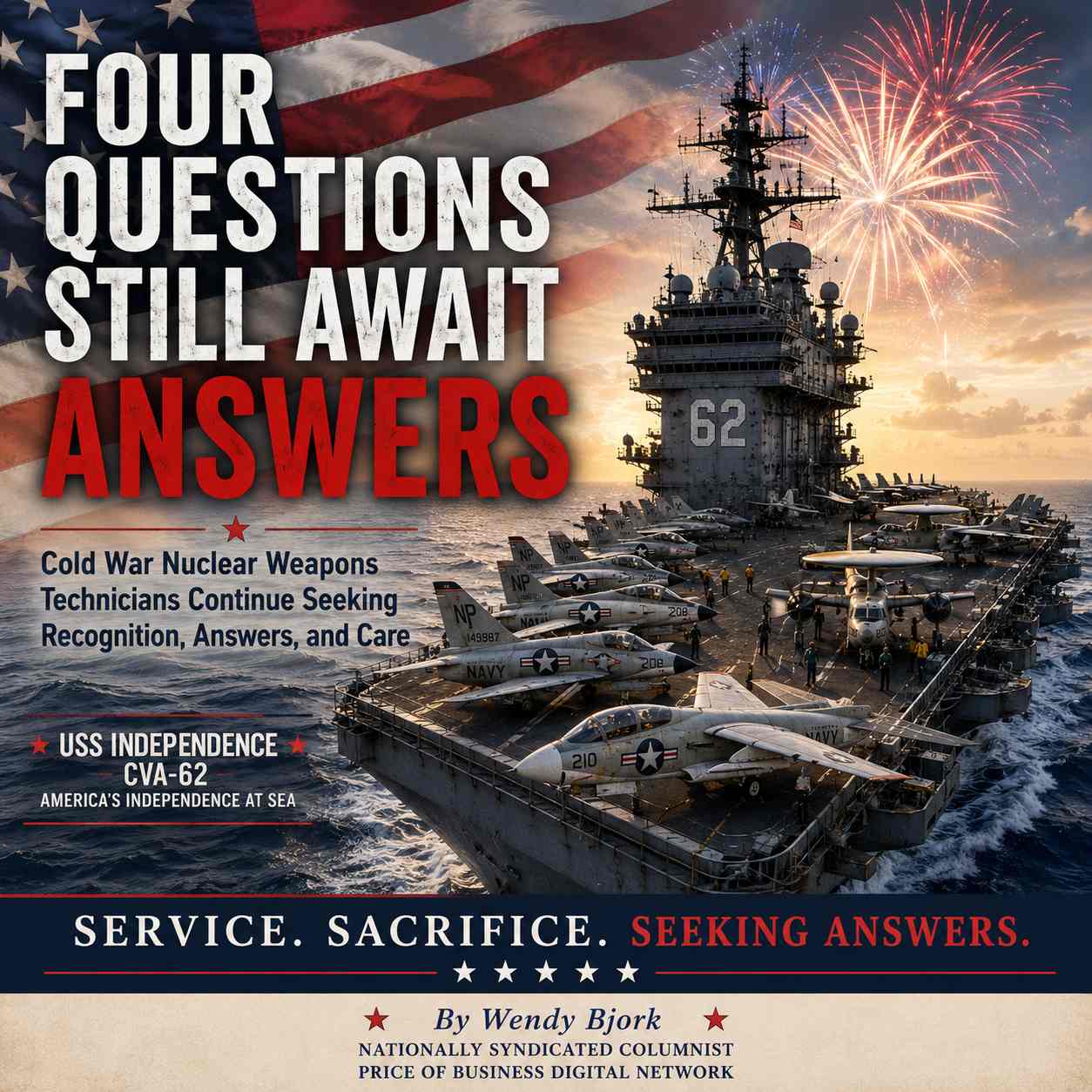
My interest in this issue is both professional and personal. My father served aboard the USS Independence CVA62 from 1961 to 1965 as a Nuclear Weapons Technician responsible for maintaining live nuclear weapons during the Cold War. Through my work as a nationally syndicated columnist and radio show host, I have also spoken with veterans, family members, advocates, researchers, and elected officials who continue to raise questions about radiation exposure and long-term health effects among those who worked directly with nuclear weapons.
The questions submitted to the Secretary’s office were straightforward.
First, what is the VA’s understanding of the unique occupational exposures experienced by Cold War Nuclear Weapons Technicians?
Second, how should the VA evaluate claims when veterans believe they were exposed during service, but exposure records are incomplete, unavailable, or may never have been created?
Third, would the VA support a formal review of Cold War Nuclear Weapons Technician exposures to determine whether current claims standards adequately reflect the realities of their service?
And fourth, what message would the Secretary like to share with Cold War Nuclear Weapons Technicians and their families who have spent years seeking recognition, answers, and access to care?
Rather than receiving answers to those questions, the response directed me to a general VA webpage regarding radiation-risk activities.
The webpage outlines existing VA information on specific radiation exposure scenarios and claims processes. However, it does not directly address the questions submitted.
It does not explain the VA’s understanding of Cold War Nuclear Weapons Technician duties.
It does not address how to evaluate claims when exposure records are missing or incomplete.
It does not indicate whether a formal review of exposures among Nuclear Weapons Technicians is being considered.
And it does not provide a message to the veterans and families who continue seeking answers.
For many veterans, those distinctions matter.
Cold War Nuclear Weapons Technicians were not participants in atomic tests. They were not observers standing miles away from a detonation site. Their duties often involved working directly with nuclear weapons, sometimes for years or decades, as part of routine military operations.
Veterans and advocates argue that their experiences deserve separate consideration and examination.
Whether one agrees with that position or not, the questions themselves remain reasonable.
How should the government evaluate claims when historical records are incomplete?
What weight should be given to occupational duties that placed servicemembers in close proximity to nuclear weapons?
Should the passage of time make it harder for veterans to receive consideration when documentation may never have existed or may no longer be available?
And what responsibility does the government have to address concerns raised by the men and women who carried out one of the most sensitive missions of the Cold War?
These questions are not going away.
The veterans who performed these duties are aging. Many have already passed away. Families continue searching for information, recognition, and understanding.
As a journalist, my responsibility is not to provide the answers. It is to ask the questions.
At this moment, four important questions remain unanswered.
And for many Cold War Nuclear Weapons Technicians and their families, that silence speaks for itself.
Related Coverage and Resources
This article is part of an ongoing effort to document the experiences of Cold War Nuclear Weapons Technicians, veterans, and military families seeking answers regarding radiation exposure and long-term health concerns associated with America’s nuclear weapons programs.
Readers interested in learning more can explore the resources and interviews below, including conversations with veterans, advocates, researchers, and elected officials working to bring greater visibility to these issues.
Congressman Mark Takano Interview
Rick Workman The Sound of Silence Project
Supporting Research Fact Sheet
As additional information becomes available, I will continue to cover this issue and seek answers to the questions that many veterans and families believe deserve greater attention.
If you are a Cold War Nuclear Weapons Technician, a family member, a researcher, or an advocate with information relevant to this topic, I welcome hearing your story.
— Wendy Bjork
Nationally Syndicated Columnist
Price of Business Digital Network
Wendy Bjork is the founder of Hearts of Wellness, a platform dedicated to guiding women navigating Multiple Sclerosis toward radiant, rooted, resilient living. She is an international bestselling co-author, nationally syndicated columnist, and inspirational speaker who teaches from 35 years of lived experience with MS. Her signature framework, the Four Roots of Luminous Living, centers on Clarity, Vibrancy, Harmony, and Connection as the foundation for sustainable healing and empowered daily life.
Wendy’s work includes programs, workbooks, guided experiences, keynote speaking, and a book currently in progress. She is a featured voice on the Price of Business network and a passionate advocate for women who are ready to move beyond survival mode.
Follow Wendy HeartsOfWellness.com/Social
Twitter/X: @bjork_ms
FB page: Wendy Bjork Hearts of Wellness
YouTube Channel: www.youtube.com/@wendybjork
LinkedIn: https://www.linkedin.com/in/wendybjork
Instagram: @theempressofms
Pinterest: pinterest.com/EmpressofMS
For more great lifestyle content, see here.
Explore more insights at https://dailymailusa.com/.